
Exhausted But Can’t Shut Off? Here’s What’s Actually Happening
May 12, 2026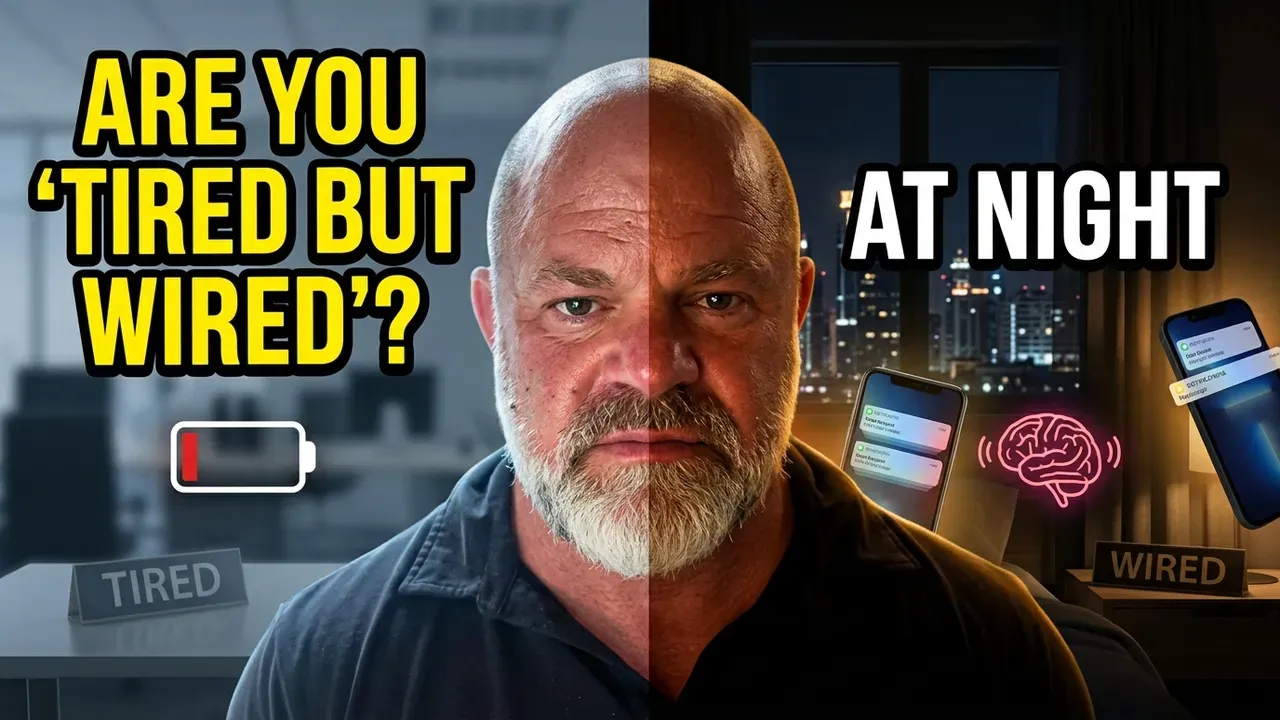
Have you ever been exhausted all day, but the second it’s time to relax, your brain turns on?
You’re tired.
You know you need sleep.
You want to shut down.
But your body feels like it is still running.
Your mind is going. You’re thinking about work. You’re replaying conversations. You’re thinking about everything you didn’t get done. You’re scrolling on your phone even though you know it is probably making things worse.
And the most frustrating part is this:
You may be doing a lot of the “right” things.
You may be exercising. Trying to eat better. Taking supplements. Working hard. Pushing yourself. Trying to get your life back under control.
But you still feel exhausted.
And at night, you still can’t shut off.
So what is actually happening?
A lot of people think this is just a sleep problem.
But most of the time, it is bigger than that.
Your body may be tired, but your nervous system is still on alert.
That is the key.
Your Body Is Tired, But Your System Is Still On
When you are exhausted but can’t shut off, your body wants rest, but your system does not feel like it can fully relax.
It is like your foot is on the gas and the brake at the same time.
You are drained, but wired.
You are exhausted but alert.
You want to sleep, but your body is acting like there is still something to handle.
That is why you can feel completely worn out and still lie in bed wide awake.
That is why you can say, “I’m so tired,” and then stay up another hour scrolling.
That is why rest can feel uncomfortable.
Your system has been trained to stay on.
And for a lot of hard-charging people, this starts to feel normal.
You wake up and check your phone.
You start the day already reacting.
Emails. Messages. Work. Deadlines. Family responsibilities. Notifications. Caffeine. More work. More pressure.
Then maybe you try to squeeze in a hard workout because you feel like you need to get back in shape.
Then at night, you try to relax with your phone, TV, alcohol, snacks, or more scrolling.
But none of that really tells your body the following:
“We are safe now.”
“We can come down now.”
“We can recover now.”
Instead, the system stays stimulated.
By the time you get to bed, your body is exhausted, but your brain is still running the same program it ran all day:
Go.
Handle.
Fix.
Respond.
Check.
Think.
Prepare.
Push.
That is the loop.
This is not laziness. It is a capacity problem.
Most people try to fix this by pushing harder.
They say:
“I just need more discipline.”
“I need to train harder.”
“I need to wake up earlier.”
“I need to be stricter with my diet.”
“I need to stop being lazy.”
But this is usually not laziness.
It is not weakness.
It is often a capacity problem.
You have more stress coming into the system than your body has the ability to recover from.
Think of it like a bathtub.
Every stressor adds water to the tub.
Work stress adds water.
Bad sleep adds weight.
Caffeine adds water.
Screens add water.
Hard workouts add water.
Arguments add water.
Financial pressure adds water.
Being inside all day adds water.
Not moving enough adds water.
Not eating enough protein adds weight.
Not getting real sunlight adds moisture.
Not having any quiet time adds fuel to the fire.
Eventually, that bathtub starts to overflow.
And when it overflows, you do not feel like yourself.
You feel tired.
Foggy.
Irritable.
Anxious.
Stiff.
Unmotivated.
Hungry at night.
Sore all the time.
Wired but exhausted.
And what do most people do?
They add more.
More caffeine.
More intensity.
More scrolling.
More supplements.
More complicated routines.
More pressure.
But sometimes the answer is not more.
Sometimes the answer is to drain the tub.
You Cannot Stay Stimulated All Day and Expect Deep Rest at Night
A major reason people cannot shut off is overstimulation.
Most people are not under-motivated.
They are overstimulated.
There is a big difference.
Your brain is getting hit all day with input:
Phone notifications.
Emails.
Messages.
News.
Social media.
Deadlines.
Noise.
Artificial light.
Caffeine.
Constant information.
Constant comparison.
Constant pressure.
Then people wonder why they can’t relax.
Of course you can’t relax.
Your system has been getting poked all day.
If your whole day is go, go, go, bedtime becomes the first time your brain has had any space.
That is when the thoughts hit.
That is when the tension shows up.
That is when you remember everything you forgot.
That is when your body finally says the following:
“Hey, we need to deal with all this.”
So if you are only trying to fix this at night, you are missing the bigger picture.
You need to start regulating your system during the day.
The Basics Matter Because They Change the Signal
This is where the basics matter.
Not because they are fancy.
Not because they are exciting.
But because they work.
Your body responds to signals.
Light is a signal.
Movement is a signal.
Food is a signal.
Stress is a signal.
Your phone is a signal.
Caffeine is a signal.
Training is a signal.
If all the signals say “stay alert,” your body is going to stay alert, even if you are exhausted.
That is why this is not just about sleep.
It is about the way your whole day is set up.
Start With Walking
A 10-minute walk outside can change the signal.
It gets you away from the screen.
It gets your body moving.
It exposes you to natural light.
It gives your brain a break.
It tells your system:
“We are not trapped.”
“We are not stuck.”
“We can move.”
Walk after meals if you can.
Breakfast, lunch, and dinner.
Even 10 minutes.
That alone can help you feel better during the day and less heavy after meals.
Fix Your Light Environment
Get outside early in the day.
Let your body know it is daytime.
Then at night, do the opposite.
Dim the lights.
Get off the phone earlier.
Stop blasting your eyes with bright screens right before bed and then wondering why your brain won’t shut off.
Your body is not a machine.
It responds to the environment you put it in.
If you give it daytime signals at night, do not be surprised when it struggles to shut down.
Eat Protein at every meal.
A lot of people are running on caffeine, stress, and random snacks.
They skip meals.
They under-eat during the day.
Then they get cravings at night.
Their energy crashes.
Their mood is all over the place.
Their body never feels stable.
Start simple.
Get protein at every meal.
Breakfast, lunch, and dinner.
Protein.
Do not make it complicated.
That gives your body something to build from. It supports energy, recovery, training, and stability.
Stop Using Hard Workouts as Punishment
This is where a lot of driven people mess up.
They feel bad, so they think they need to work out harder.
They think they need to punish themselves back into shape.
But if your recovery is already poor, harder is not always better.
Hard workouts are stressful.
They can be good stress when your body can adapt to them.
But if your body is already overloaded, more intensity can push you deeper into the hole.
That does not mean stop training.
It means train smarter.
The goal is not to prove how tough you are.
The goal is to build a body that can recover, adapt, and perform.
There is a difference between training and just draining yourself.
A lot of people do not need another brutal workout.
They need consistency.
They need to walk.
They need basic strength work.
They need better sleep.
They need better recovery.
They need to stop treating their body like a stolen car.
You can only run hard for so long before something starts breaking down.
A Lot of High Achievers Do Not Know How to Relax
This is something people do not talk about enough.
A lot of high achievers do not actually know how to relax.
They know how to work.
They know how to push.
They know how to solve problems.
They know how to be responsible.
They know how to be available.
They know how to take care of everyone else.
But relaxing?
That feels uncomfortable.
Sitting still feels like wasting time.
Taking a walk without the phone feels boring.
Going to bed earlier feels impossible.
Turning off notifications feels like you might miss something.
But that is exactly the point.
Your body has adapted to being constantly stimulated.
Now calm feels strange.
Quiet feels strange.
Stillness feels strange.
You have to rebuild that skill.
And you do not rebuild it by forcing yourself to meditate for an hour on day one.
You start small.
Ten minutes outside with no phone.
A walk after dinner.
Lights down earlier.
No phone in bed.
A few minutes of quiet before sleep.
A real conversation instead of more scrolling.
A slower morning instead of immediately grabbing the phone.
These little things may sound simple.
But simple does not mean easy.
And simple does not mean weak.
Simplicity done consistently is powerful.
Stop Asking What Else You Can Add
The problem is that most people keep looking for the advanced answer while ignoring the foundation.
They want the perfect supplement.
The perfect workout plan.
The perfect biohack.
The perfect morning routine.
But they are still staying up too late.
They are still checking their phone all day.
Still skipping meals.
Still living on caffeine.
Still sitting inside all day.
Still training too hard for the state their body is in.
Still wondering why they are exhausted but can’t shut off.
At some point, you have to stop asking the following:
“What else can I add?”
And start asking:
“What is keeping my system turned on all day?”
That is the better question.
Is it the phone?
Is it caffeine too late?
Is there no sunlight?
Is it too much intensity?
Is it not enough food?
Is it work stress?
Is it poor boundaries?
Is it the fact that you never actually pause?
Because the body keeps score.
You can ignore the warning signs for a while.
You can push through.
You can keep grinding.
You can keep saying, “I’m fine.”
But eventually, your body will force you to listen.
That is what burnout often is.
It is not just being tired.
It is your body saying the following:
“We cannot keep running like this.”
What to Do Starting Today
If you are exhausted but can’t shut off, do not try to fix everything at once.
That is where people get overwhelmed.
Pick one or two things.
Start here:
1. Get outside for 10 minutes in the morning
No phone. Just walk.
2. Get protein at your meals
Do not overcomplicate it. Start with breakfast, lunch, and dinner.
3. Walk after dinner
This helps you transition out of the day and away from screens.
4. Dim the lights earlier
Let your body know the day is ending.
5. Put the phone away before bed
Your brain does not need more stimulation when you are already wired.
6. Train smarter
Do not punish yourself with workouts your body cannot recover from.
You Are Probably Not Broken. You are probably overloaded.
You are not broken.
You are probably overloaded.
And the way out is not more punishment.
The way out is rebuilding capacity.
You want to become the kind of person who can handle stress and recover from it.
That is the goal.
Not just more productivity.
Not just more workouts.
Not just more discipline.
You need recovery capacity.
Because health is the one asset you cannot buy back later.
And if you keep ignoring your body, eventually your body will make the decision for you.
So start small.
Walk.
Get outside.
Eat protein.
Hydrate.
Lower the stimulation.
Train smarter.
Get real rest.
Have real conversations.
Give your body a reason to believe it can come down.
That is how you start getting out of the loop.
Leave a Comment
Which one sounds most like you?
1 — Exhausted all day but wired at night
2 — Can’t relax without your phone
3 — Training hard but not recovering
4 — Waking up tired even after sleeping
5 — Brain won’t shut off at bedtime
Leave a comment below with the number that fits you best.
And add one sentence about what you are struggling with most right now.
A lot of people are dealing with this quietly.
Sometimes the first step is simply saying
“Yeah, that’s me.”

